A Calcium Softgel is widely used in pharmaceutical and nutraceutical formulations to deliver calcium supplements with high bioavailability and patient convenience. Compared with tablets, a Calcium Softgel offers easier swallowing and better protection of sensitive ingredients. However, these advantages rely on one critical factor: the mechanical integrity of the softgel shell.
To guarantee performance and safety, manufacturers must understand and apply softgel rupture testing as part of routine quality control.
This introduction explains why Calcium Softgel rupture testing matters, how testing methods work, and how related material properties and standards support reliable evaluation.
Softgel Rupture Testing and Bloom Strength of Soft Gelatin Capsule
Испытание на разрыв мягкой оболочки evaluates the force required to break or penetrate a softgel shell under controlled conditions. For a Calcium Softgel, this test simulates stresses experienced during filling, packaging, transportation, and handling. Closely linked to this process is the bloom strength of soft gelatin capsule, which describes the inherent gel strength of the gelatin material forming the shell.
To fully characterize softgel behavior, laboratories increasingly rely on texture analysis. This analytical approach measures force, displacement, and deformation, providing a deeper understanding of how a Calcium Softgel responds to mechanical stress rather than relying on a single hardness value.
Why Calcium Softgel Rupture Testing Is Essential
A Calcium Softgel must balance strength and flexibility. If rupture strength is too low, capsules may burst or leak during packaging. If it is too high, the shell may crack under localized stress or resist proper rupture during ingestion.
Softgel rupture testing helps manufacturers:
- Verify shell integrity before market release
- Detect formulation or process variations early
- Reduce product loss caused by breakage or leakage
Because calcium formulations often have higher fill density, mechanical stress on the shell increases. This makes rupture testing especially important for Calcium Softgel products.
Understanding the Role of Bloom Strength in Softgel Performance
Сайт bloom strength of soft gelatin capsule reflects how firm the gelatin gel becomes under standardized conditions. Higher bloom strength generally leads to stronger, more rigid shells, while lower bloom strength increases flexibility. For a Calcium Softgel, neither extreme works well on its own.
Manufacturers typically optimize bloom strength to achieve sufficient rupture resistance without sacrificing elasticity. Monitoring bloom strength at the raw material stage ensures consistency before capsule production begins, while rupture testing confirms performance in the finished product.
Texture Analysis as a Tool for Softgel Evaluation
Texture analysis provides a comprehensive way to evaluate Calcium Softgel mechanical properties. Instead of judging quality by appearance or manual handling, texture analysis captures force–displacement curves during compression or penetration.
These curves reveal key information, including:
- Initial resistance of the shell
- Elastic deformation behavior
- Peak force at rupture
By analyzing this data, quality control teams gain insight into both rupture strength and structural behavior, supporting more informed decisions.
Typical Softgel Rupture Testing Procedure
A standardized rupture test for a Calcium Softgel usually follows a clear sequence:
- Place the softgel on the test platform in a stable orientation.
- Select a probe designed to match capsule size and shape.
- Apply force at a controlled speed to ensure repeatability.
- Record force and displacement until rupture occurs.
Consistent test speed and alignment remain critical to achieving reliable and comparable results across batches.
Supporting Quality Control with Advanced Instrumentation
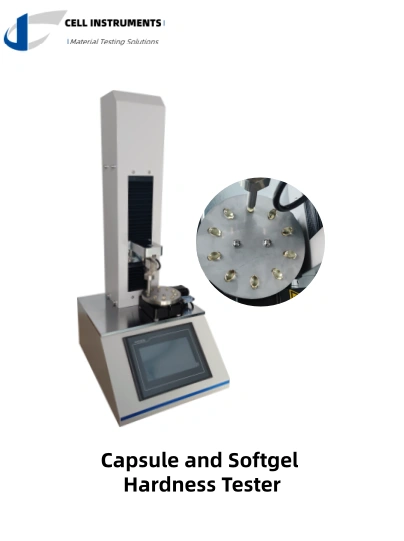
Modern quality control demands precise and repeatable testing tools. The Cell Instruments CHT-01 Capsule and Softgel Hardness Tester supports softgel rupture testing through controlled force application and multiple test modes. Its ability to perform peak force analysis, deformation testing, and elasticity assessment makes it well suited for Calcium Softgel evaluation.
Instead of relying on subjective judgment, laboratories can use quantitative data to optimize formulations, validate processes, and document compliance.
Practical Benefits for Manufacturers and QC Teams
Implementing structured rupture testing delivers measurable benefits:
- Improved batch-to-batch consistency
- Reduced risk of packaging failures
- Better understanding of gelatin behavior under stress
For Calcium Softgel manufacturers, these advantages translate directly into higher product reliability and stronger market confidence.
Conclusion: Building Confidence in Calcium Softgel Quality
A Calcium Softgel must remain intact throughout its lifecycle while delivering nutrients effectively. Through systematic softgel rupture testing, careful control of bloom strength of soft gelatin capsule, and advanced texture analysis, manufacturers achieve this balance with confidence.
By integrating these methods into routine quality control and using professional instruments such as the Cell Instruments CHT-01, pharmaceutical and nutraceutical producers ensure that every Calcium Softgel meets the expectations of regulators, professionals, and consumers alike.
 RU
RU  EN
EN  AR
AR  BG
BG  CS
CS  DA
DA  DE
DE  EL
EL  ES
ES  ET
ET  FI
FI  FR
FR  HU
HU  ID
ID  IT
IT  JA
JA  KO
KO  LT
LT  LV
LV  NB
NB  NL
NL  PL
PL  PT
PT  RO
RO  SK
SK  SL
SL  SV
SV  TR
TR  UK
UK